

England, 1817
It's just past eight when he opens the door. The smell of wool dust and stale wood smoke hangs in the air, like every evening. His wife turns from the stove, looks at him, just briefly, then back to the pots. He hangs his coat on the nail and sits down.
His son, maybe six years old, looks up from the floor. "Papa, what's a power loom?"
He lifts his head. "Who told you that?"
"The men at the market."
He doesn't answer. Takes some bread. Tears it in half.
His father sat at this loom. His grandfather too. He knows the sound of the shuttle as well as his own breathing, the tension of the thread right before it snaps, when wool is good and when it lies. He isn't a worker. He's a craftsman. What he doesn't know: that this word will mean nothing in a few years.
There are 240,000 hand weavers in England at this point. Forty years later, only 23,000 are left. Over 90% gone.
Berlin, 1998
It's Tuesday, just before half past ten. She walks to the coffee machine, like every day. The fluorescent tube above her hums, keyboards clatter behind her. In front of her, a small table with catalogs: Portugal, Mallorca, the Canary Islands. Thick. Glossy. She knows them by heart.
"Did you read this?" Thomas leans against the machine and folds a page shut. "Booking-dot-com. They say you can book a holiday on the internet now."
She laughs, not unkindly, just the way you laugh when something sounds truly absurd. "Who books a holiday on a computer?"
"No idea." He shrugs. "The Americans, I guess."
She carries her coffee back to her desk, flips open a catalog. Sicily, page 34. A couple on a terrace, sunset. She types in a booking. Outside, the tram rolls by.
In the US, there are still 124,000 travel agents in 2000; by 2019 it's 82,000. In the UK, the brick-and-mortar travel agency sector nearly halves between 1997 and 2013, down 59%. Secretarial jobs in the US: down 1.1 million between 2000 and 2010.
Frankfurt, 2026
32nd floor. Glass facade. View over the river Main. 3:41pm. You're sitting at your laptop. In the last three hours you've built an analysis of three new markets, with ChatGPT. Built a presentation, with Claude. Sent an email to the board. Prepped a client call. All of it with AI, all of it faster than before. You've gotten pretty good at this, honestly.
And yet.
Something's been off lately. You're not sleeping as well. Everything is fine, really: you're successful at work, your relationship is better than ever, you just beat your own personal record on the bike. And yet there's this unease. Like a window left open a crack, and you feel the draft without knowing where it's coming from.
Is this enough? Is my job still safe? What does the future hold?
You use AI every day, for almost everything. But what if in two years nobody needs someone to steer the AI anymore? Or, worse, what if there's someone who can simply do it better than you. Younger. Faster. Cheaper. Grown up with AI the way you grew up with Google.
You already know your counterargument: technology waves don't destroy jobs, they shift them. When the PC arrived in offices, the accountant didn't disappear, he got more productive. Okay, maybe. But the accountant of 1985 learned Excel. The knowledge worker of 2001 understood Google. The travel agent of 1998 didn't learn anything new. She stuck with the catalog.
You don't know which of your skills will still count in four years. That's not the end of the world. It's just a question you're asking out loud, but it's there.
The World Economic Forum says in its Future of Jobs Report 2025: by 2030, 92 million jobs will disappear worldwide, 170 million new ones will emerge. Sounds like a net gain. But: 39% of today's skills will be obsolete by 2030. Not yesterday's jobs, today's skills. Four years. Not forty.
The AI Disruption Score
This month we launched the AI Disruption Score, inspired by deathbyclaude.ai. A small prediction of when your job gets disrupted. A bit exaggerated, and still somewhere close to the current reality.
You give it your LinkedIn profile URL, the AI analyzes what you do, and you get a score back: how disruptable is your job in the coming years? Plus recommendations: which skills matter, which niche in your field is growing, which tools to learn today, how to use your strengths.
Using AI for your own positioning
The analysis based on a LinkedIn profile probably isn't enough, too little context for good results. If you want to go deeper, here's what I'd recommend: let the AI interview you, about your job, your tasks, your strengths. Everything it needs to know to figure out how it could replace you. Absurd, right?
Go to ChatGPT, Claude, or Gemini, I recommend Claude Cowork, and write exactly this:
You're a futurist focused on AI and labor markets. Your task: figure out which of my professional tasks could be disrupted by AI. How I can already use AI in my job today. And how I can use my strengths so I don't get disrupted by AI.

Start with an interview and first ask me all the questions you need to understand my job profile. Ask me about my job, my daily tasks, my skills, my industry, the size of my company, everything you need to know to give me a truly honest and precise assessment. Don't sugarcoat anything, be 100% honest!

Start with the questions. I'll answer. Then you analyze.
The difference from a normal prompt: you don't tell the AI what it should know. You let it ask what it needs to know to do the job. The result is noticeably better, and you're forced to think about your own job while you answer.
Give it a try, maybe in a session with friends, that kind of thing can really spark something.
Why inzpyre.me?
Now it gets personal. If you know me, you know: I'm not a fan of our education system. When I reflect on my school years and my degree today, it feels like I could have used that time so much better. Why do we learn so many things we never need later? Why do we learn subjects instead of skills? These questions never let go of me, not even at 30. And you can't complain about something forever without offering a solution yourself. That's why I founded inzpyre.me.
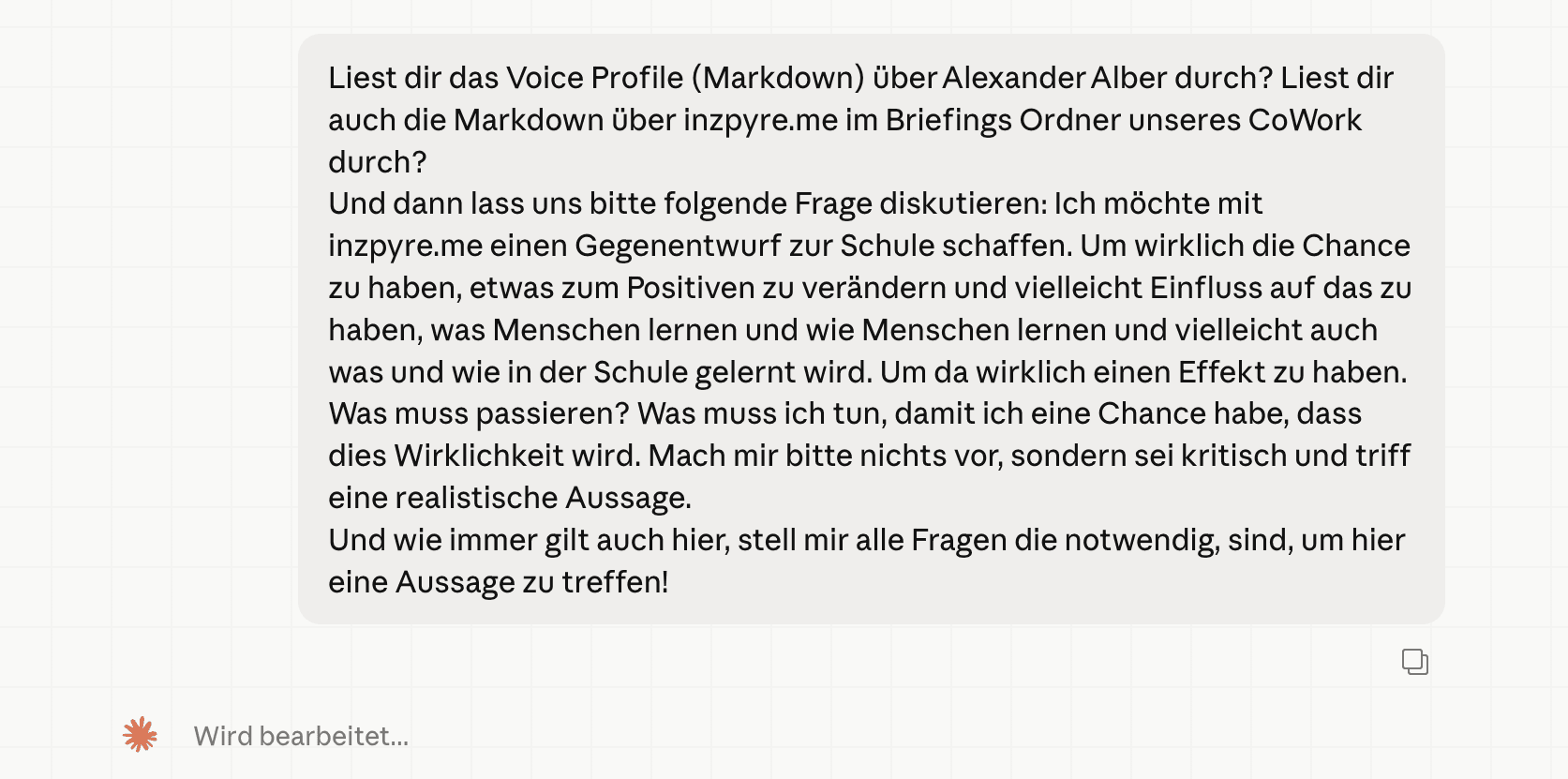
A few days ago, I asked the AI.
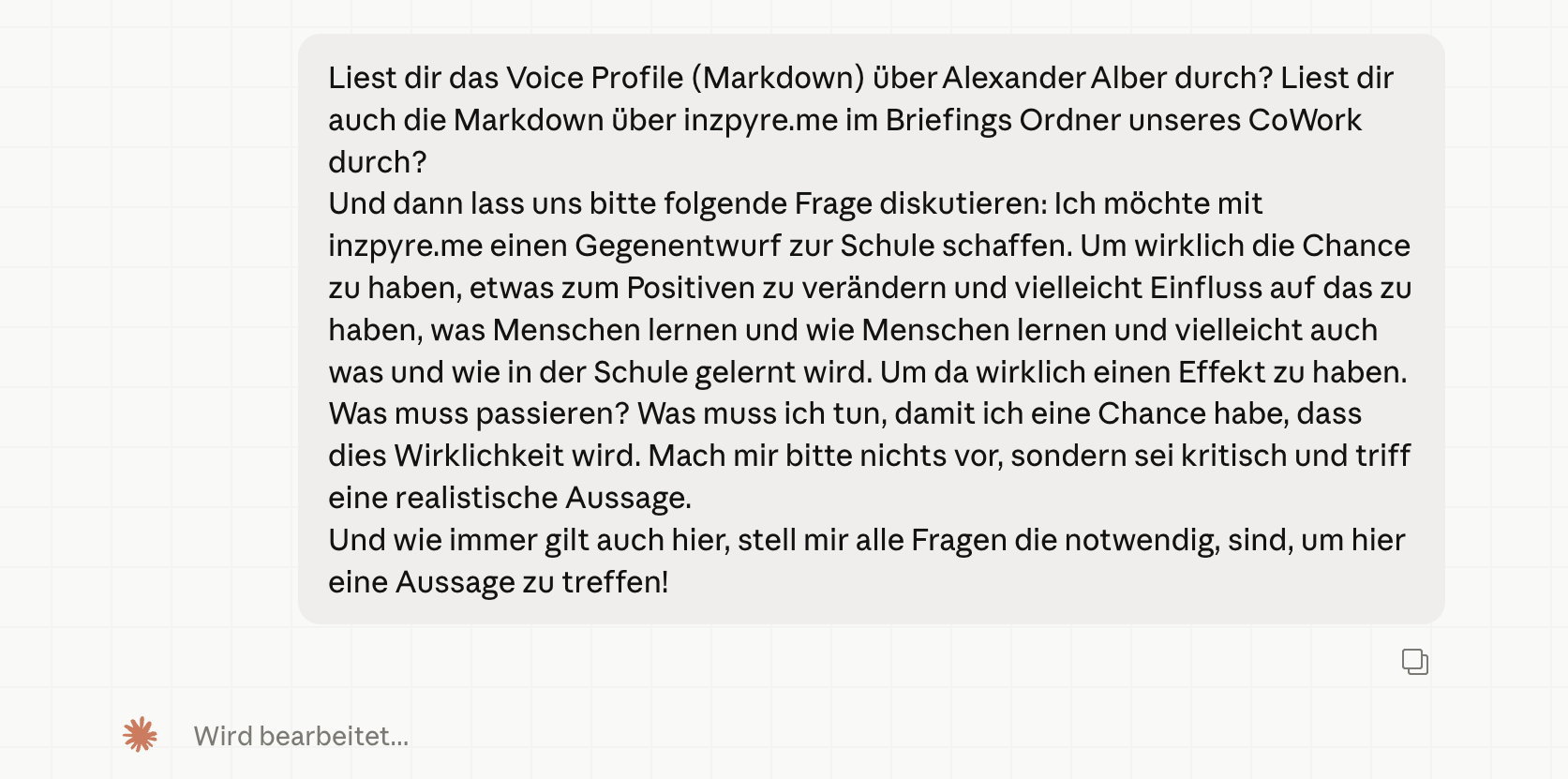
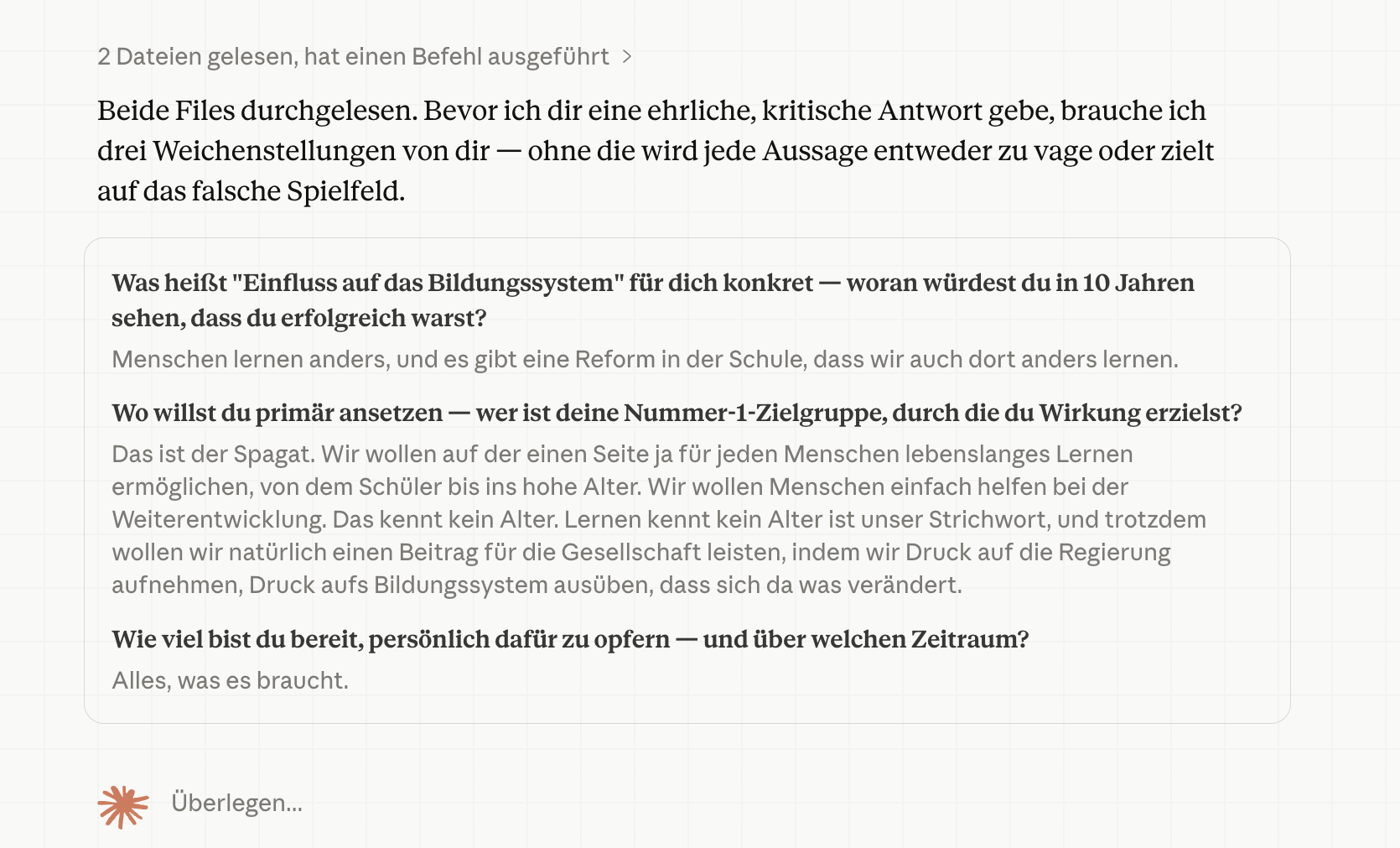
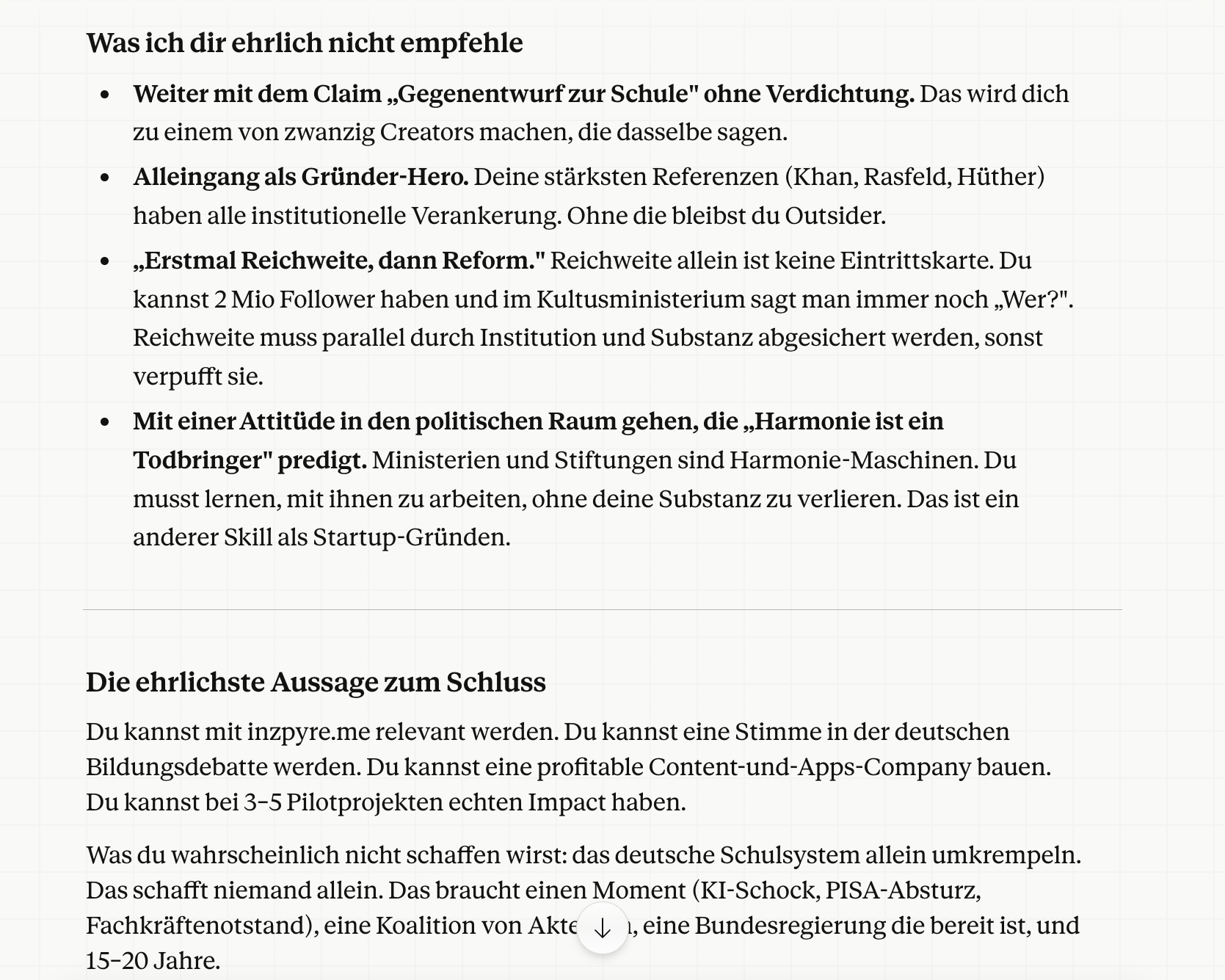
The answer was uncomfortably honest.
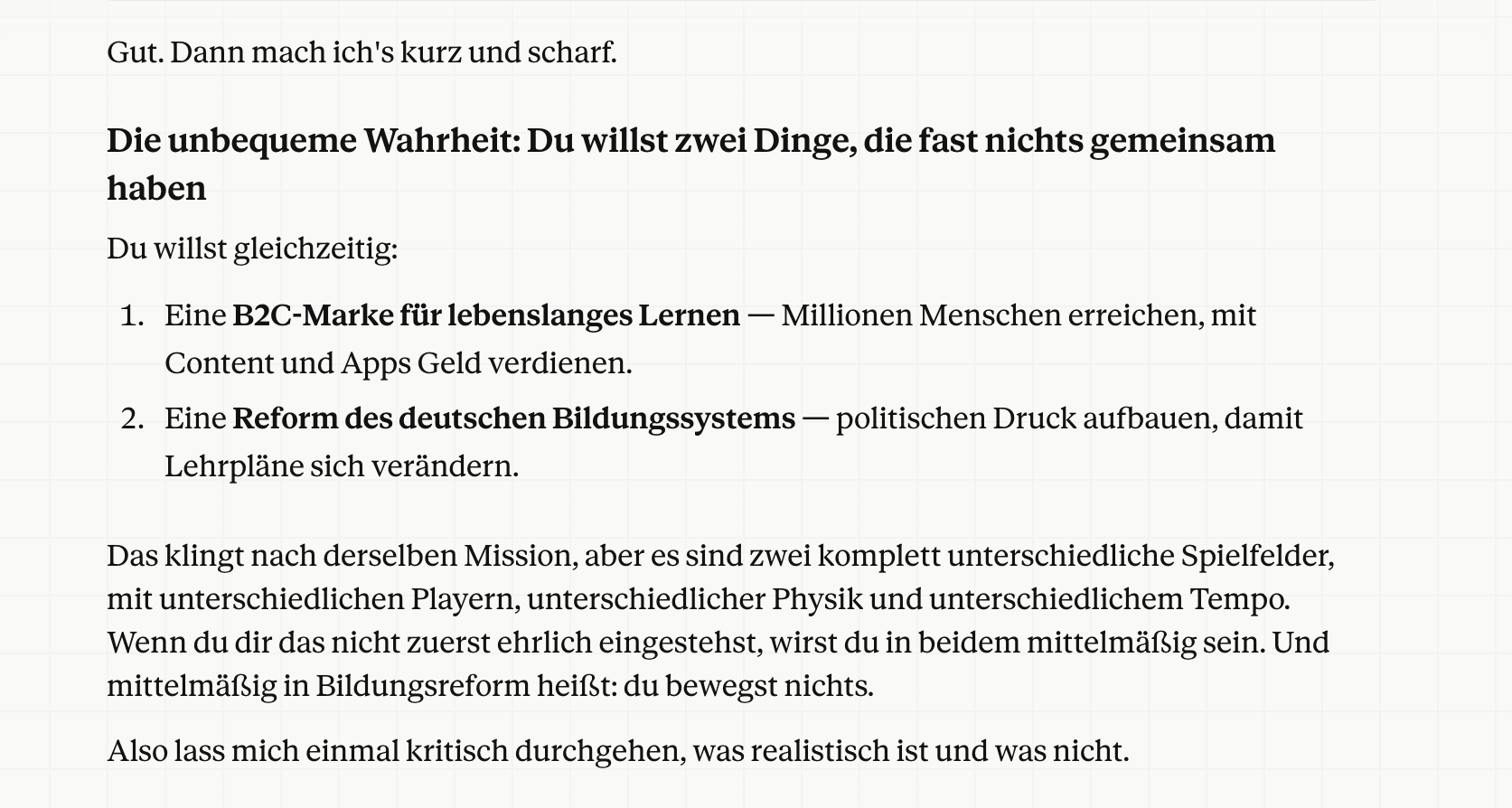
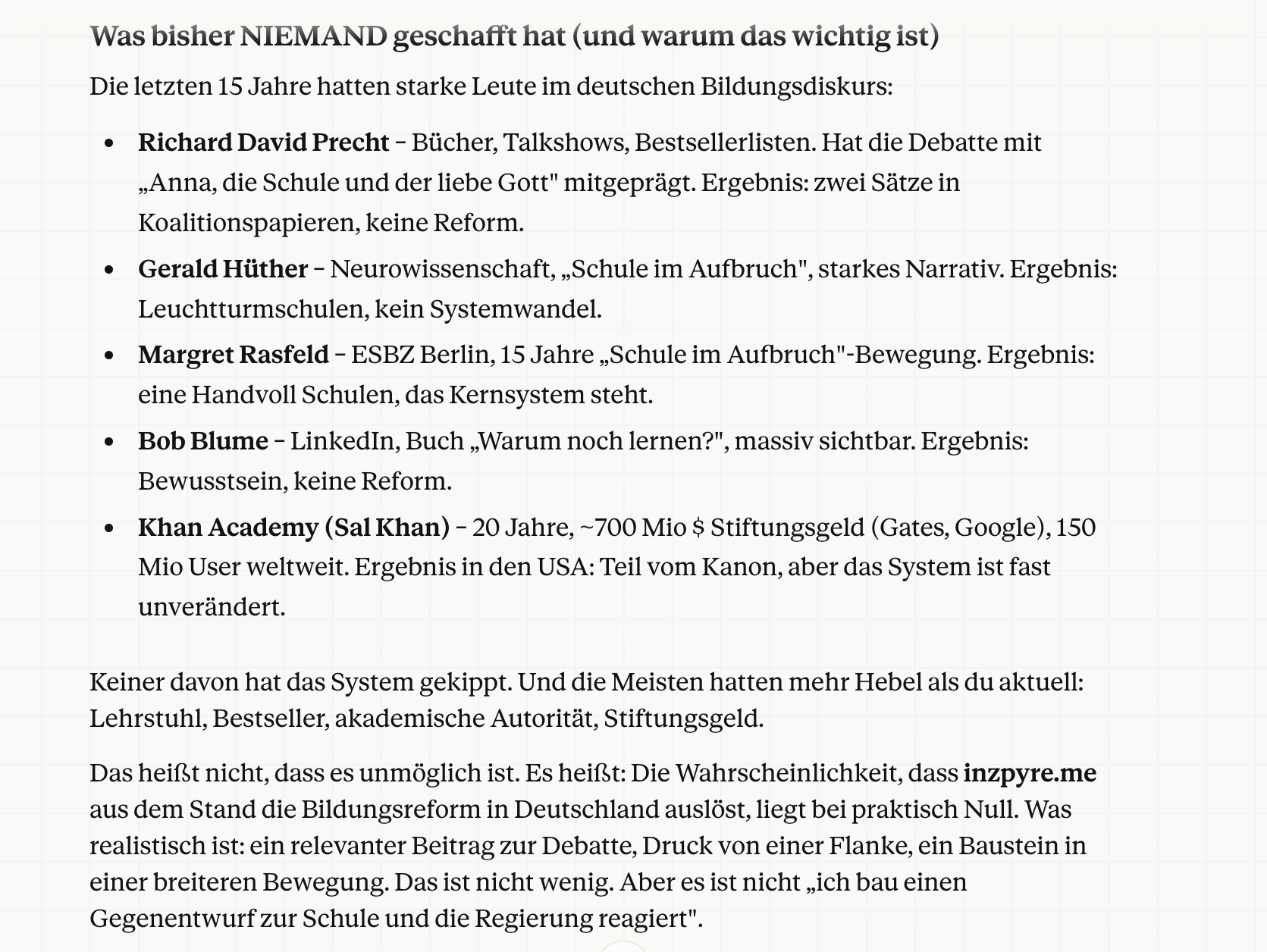
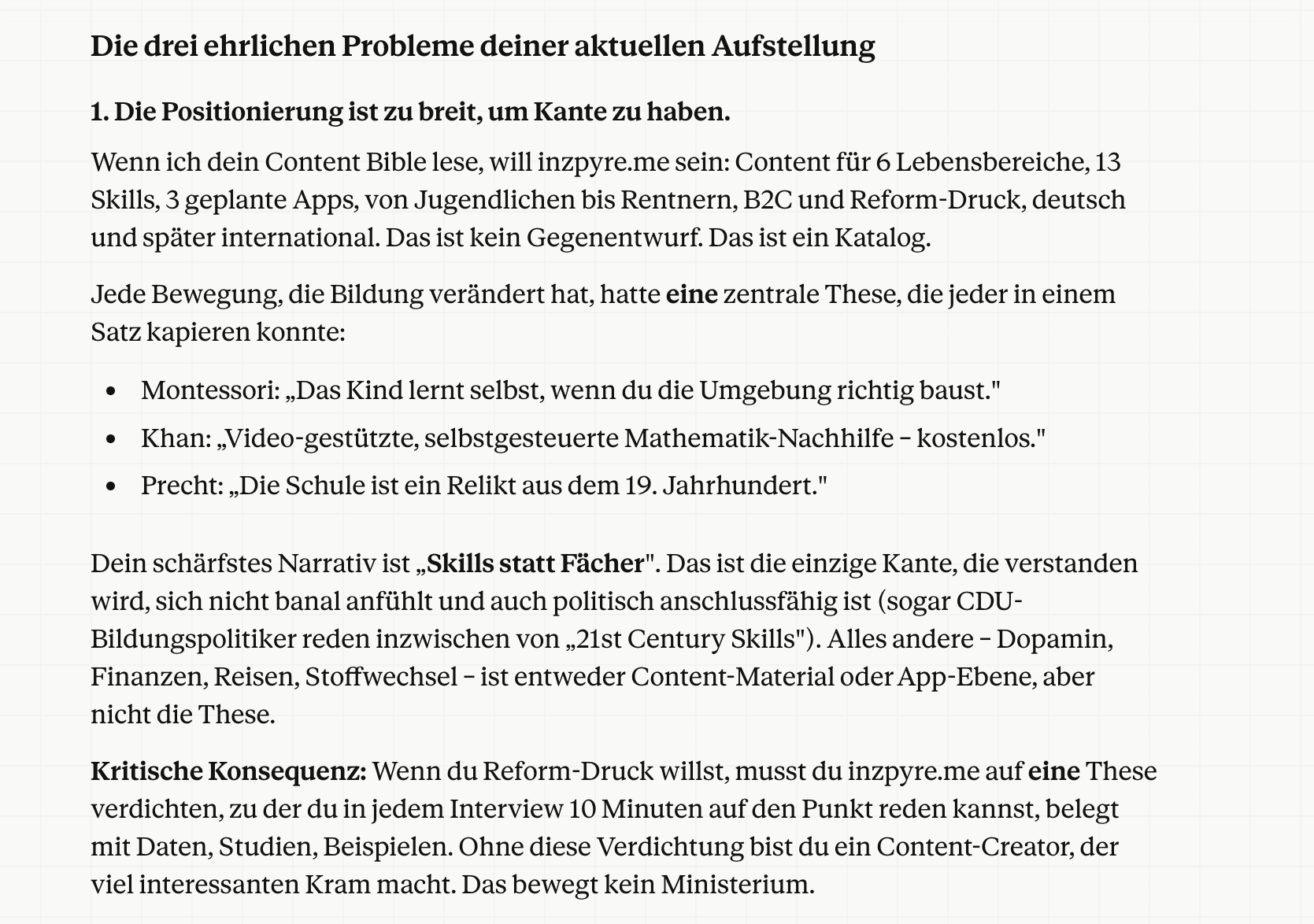
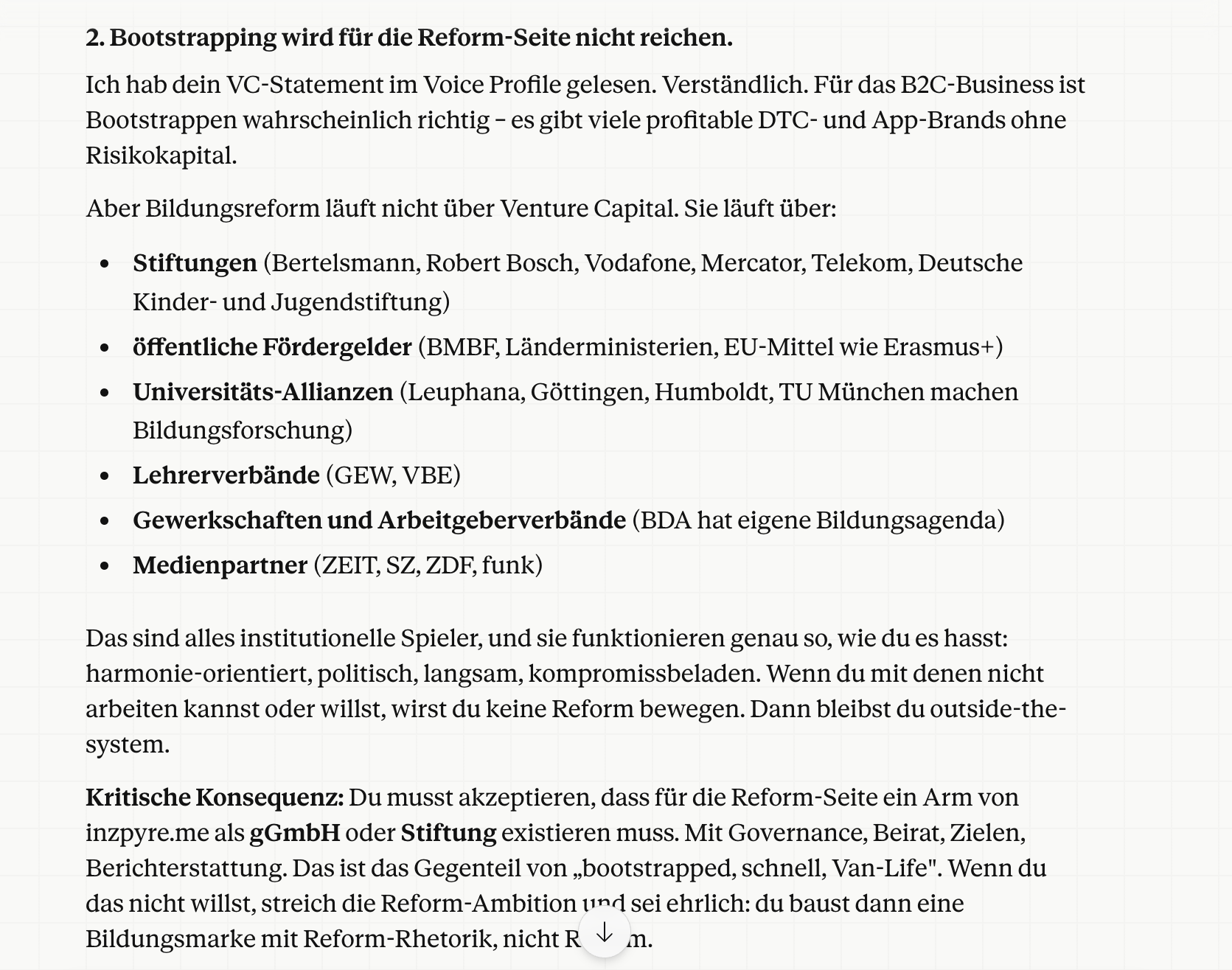
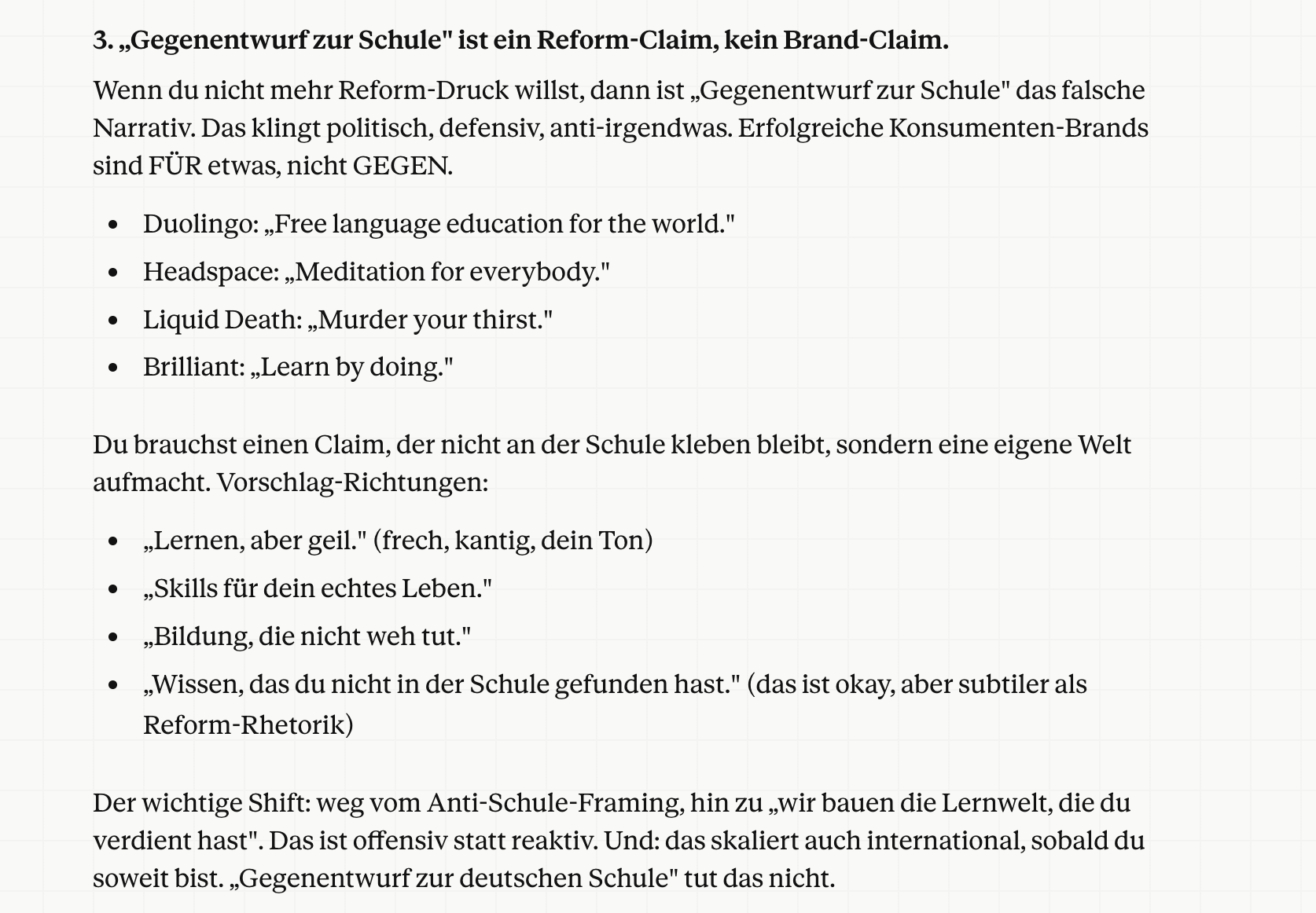
Ouch, that landed. But probably true.
Education reform in the institutional sense, curricula, ministries, foundation boards, parliamentary hearings, committees, is close to impossible. Especially not while I'm also trying to start a business, make money, and build a consumer brand that promotes lifelong learning.
In the first moment: disappointment. Have I gone down the wrong path? Is this failing before it even started?
But Claude has a point, right? I looked inward: what do I actually want? And it became clear: my big goal, a "counter-model to school" in the institutional sense, might just not be realistic. I probably need to take a different path!
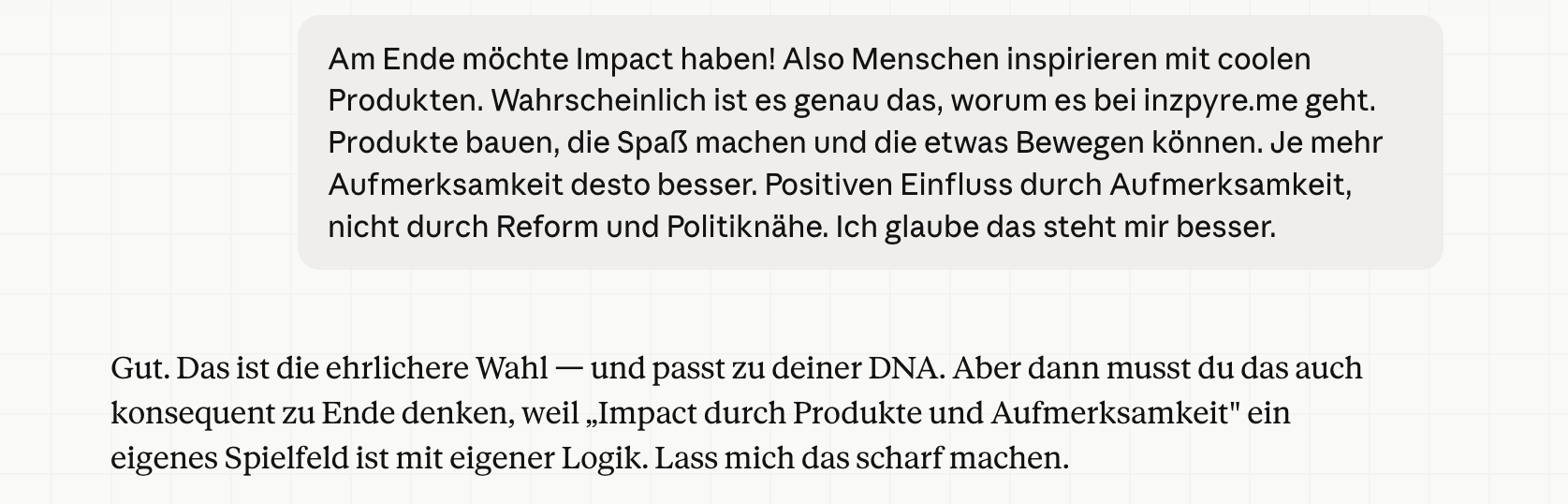
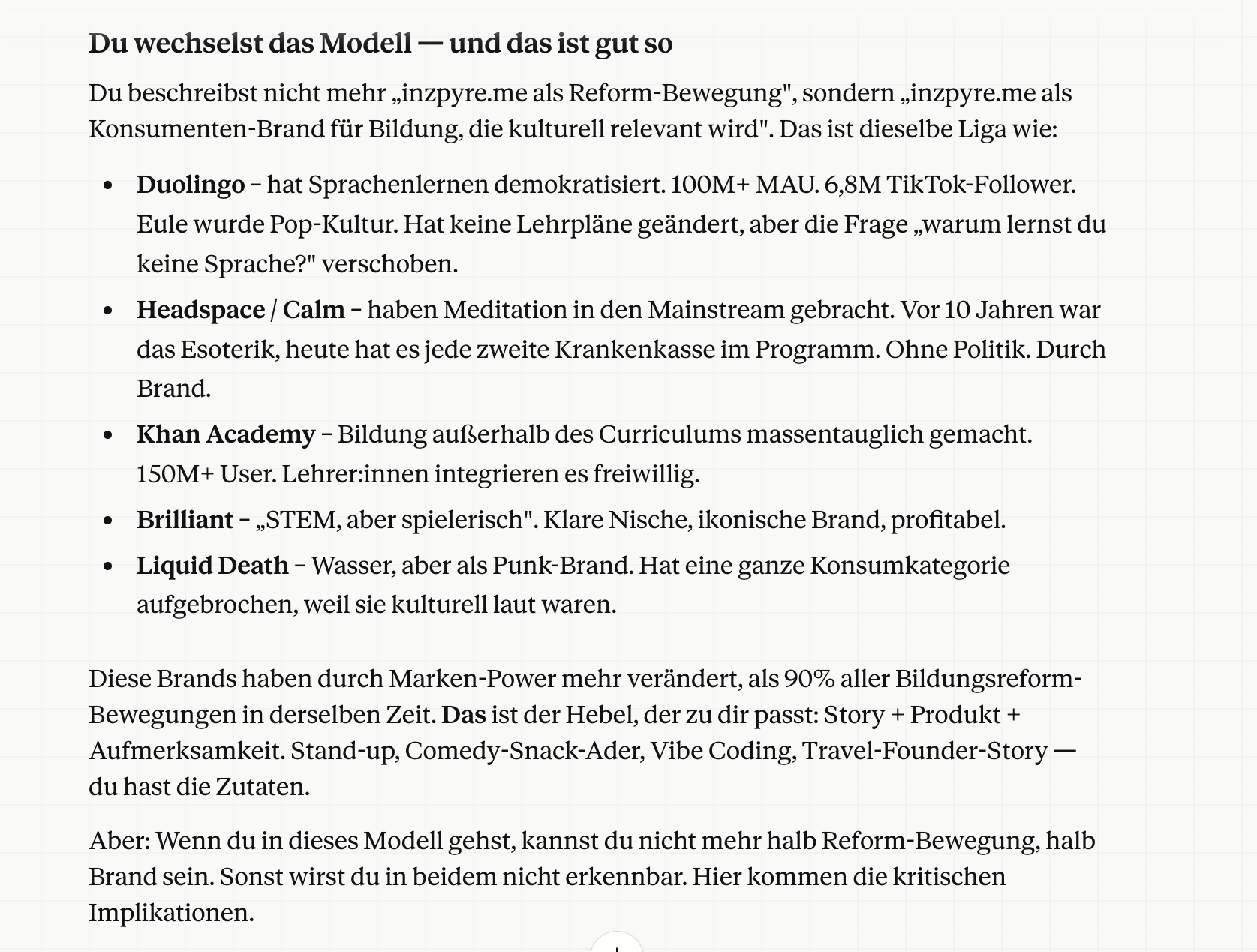
Duolingo, Headspace, Khan Academy. I don't know, is that really inzpyre.me? Is that really me? Those are VC cases, publicly traded companies. Do I want that? I want to be creative, to create, to build products, to help people, to inspire people, to excite people.
Am I still a founder, or more of a creator?
But me, a creator? Those are the people on Instagram, on TikTok, on YouTube. Me, one of them? No, I worked with companies, with the people who matter, my résumé fits together like a gear train. That doesn't add up.
I know I want to build products that are fun. Products that make you think and move something. Products like the AI Disruption Score. My impact doesn't come through reform papers, it comes through products people use voluntarily, because they're fun, because they deliver value, and because they show: learning can work differently.
My rule: if I'm not genuinely excited about a product myself, and haven't used it for at least several weeks, it doesn't ship. Promise! inzpyre.me isn't an education authority. It's a playground for people who want to grow and are looking for inspiration. A community for builders who create things.
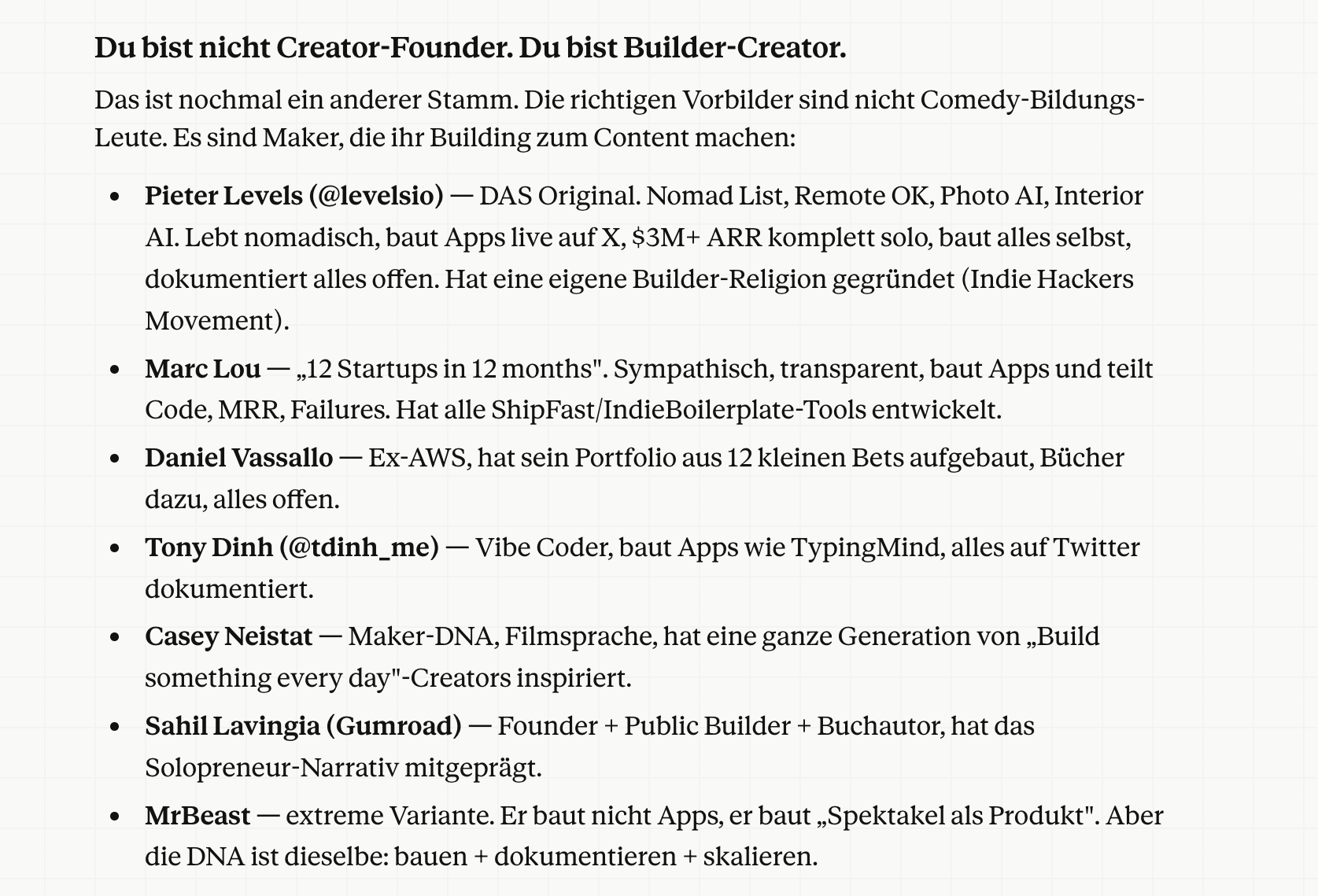
It looks like the plan has already changed.
I reflect again. Creators, communities, that's it. In times when we don't know what the future of our job looks like, when we don't know how people will work or learn in the future, that's exactly when something else takes center stage: exciting people, community, content, branding.
My mission is clear!
I just reinvented myself, and inzpyre.me with me. I'm apparently a creator now. And here too, I'm being 100% honest with myself: content creation is a skill I still have to learn. Nobody said this would be an easy path, though. Reinventing yourself is hard.
But if there's ever a good moment to reinvent yourself, it's now. I want to invite you to reinvent yourself too. Where and how has no limits.
Your challenge for this month
Another thing I want inzpyre.me to stand for: challenging yourself. We shouldn't get too comfortable, we should face the uncomfortable questions, be honest with ourselves. So with every newsletter, I try to give you a small challenge.
Let the AI interview you, about your job, your tasks, your strengths. Find out where it could replace you. But also: where you could rethink your work.
Best to download Claude Cowork first and use it for the interview. Make sure Cowork doesn't have access to everything, only to specific folders, that's also where you put your briefing files. How exactly that works and which files make sense, you'll find in our deep dive at inzpyre.me/ki.
"I don't have time to deal with AI" is a ridiculous excuse. How do I know? Because I've used it myself, often.
Ruben Hassid
He teaches AI for non-techies, currently the best thing out there on the topic. Follow him on LinkedIn or Instagram too.
Oh, and this newsletter, was it written by AI or by me? Every thought comes from me, the idea, the structure, the story, even many of the phrasings. The AI gives it shape, but it writes like me. Because I showed it how I write and how I think. If I didn't write this newsletter with AI, though, I wouldn't be credible, right?
Stay curious,
Alex
If you liked this newsletter, feel free to share it with others. In the spirit of neuroplasticity, wild word, right? At its simplest, it means: retirement planning for your brain through lifelong learning.
Sources
On hand weavers in England:
- Duncan Bythell: The Handloom Weavers: A Study in the English Cotton Industry during the Industrial Revolution, Cambridge University Press, 1969.
- Report from the Select Committee on Hand-Loom Weavers' Petitions (Royal Commission on Handloom Weavers), parliamentary report, London 1834–1841.
- E. P. Thompson: The Making of the English Working Class, Victor Gollancz, London 1963, chapter on hand weavers.
- Summary overview: Knowable Magazine, "What happens to the weavers? Lessons for AI from the Industrial Revolution" (2025).
On travel agencies and secretarial jobs:
- U.S. Bureau of Labor Statistics, Occupational Employment and Wage Statistics (OEWS), Travel Agents (SOC 41-3041): bls.gov/oes/current/oes413041.htm.
- U.S. Bureau of Labor Statistics, Occupational Outlook Handbook, Travel Agents: bls.gov/ooh/sales/travel-agents.htm.
- U.S. Bureau of Labor Statistics, Productivity growth in travel agencies, The Economics Daily: bls.gov/opub/ted/2004/sept/wk2/art02.htm.
- ABTA, Travel Trends Report (annual series) and Holiday Habits Report: abta.com/industry-zone/reports-and-publications.
- U.S. Bureau of Labor Statistics, Secretaries and Administrative Assistants (SOC 43-6000), historical employment series 2000–2010.
On job dynamics in the AI age:
- World Economic Forum: Future of Jobs Report 2025, Geneva, January 2025, weforum.org/publications/the-future-of-jobs-report-2025.
- WEF press release: "78 Million New Job Opportunities by 2030 but Urgent Upskilling Needed".
- Full-text PDF: reports.weforum.org/docs/WEF_Future_of_Jobs_Report_2025.pdf.
Inspiration for the AI Disruption Score: